




Choosing Ballet Leotards: What the Discipline Actually Requires
Ballet is the one discipline where what a dancer wears is genuinely part of the instruction rather than a matter of preference or studio tradition. An instructor correcting placement needs to see the line of the spine, the rotation at the hip, and the engagement through the ribcage, none of which is visible under loose fabric. This is why the standards for ballet leotards are more specific than for any other form, and why understanding the reasoning makes the choices considerably easier to navigate.
The requirements are not arbitrary, and knowing why they exist helps a dancer buy well rather than buy defensively.
The Instructional Reason Behind the Silhouette
A fitted leotard functions as a diagnostic surface. When a teacher says the ribs are open or the pelvis is tilted, they are reading the body through the garment, and any excess fabric obscures exactly what they need to see.
This is worth explaining to younger dancers who experience the code as a restriction. It is closer to a stethoscope than a uniform. A dancer in loose clothing receives less useful correction, which slows progress in a form where progress depends almost entirely on correction.
That said, fitted does not mean minimal. Coverage and fit are separate questions, and a well-chosen leotard can provide considerable coverage while remaining fully diagnostic.
Necklines and Backs, and What Each Does for Line
The styles carry different visual effects and different practical implications.
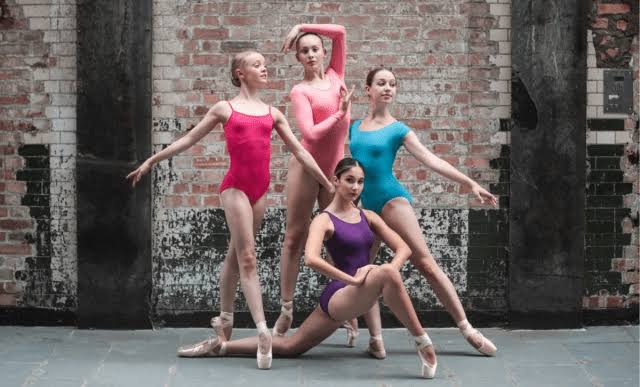
Camisole and tank fronts are the most common in technique class. Both keep the collarbone and shoulder line visible, which matters for upper body placement.
Pinch front styles gather fabric at the center chest, which some dancers find provides better shaping and support without altering the visible line.
Open backs in various configurations expose the shoulder blades, which is genuinely useful for correcting upper back engagement. Some dancers find them uncomfortable to wear, particularly during adolescence.
Higher backs remain fully code-compliant in most studios while providing meaningful coverage. The spine remains visible through fitted fabric, so the instructional purpose is preserved. Any dancer who feels exposed in an open back should know this option exists rather than assuming the style is required.
Straps and Why They Fail
Strap failure during class is disruptive and entirely preventable at purchase.
Width matters. Wider straps distribute pressure across the shoulder and stay put through port de bras. Very narrow straps slip, particularly on dancers with sloped shoulders.
Check whether straps are adjustable. Fixed straps sized for a shorter torso will pull down at the shoulder and up at the leg, which is uncomfortable and looks wrong. Adjustable straps solve most of this.
Test the fit by raising both arms fully overhead and holding. If the shoulders pull downward or the garment rides up sharply at the hip, the torso length is short regardless of what the size chart said.
The Color Question
Many ballet programs assign colors by level, which serves a practical purpose in a large school where an instructor needs to identify a dancer’s placement quickly across a crowded studio.
Where a code specifies a single color, buy within it. Where a code offers a range or is silent on color, this is where a dancer has room. Check the written code rather than assuming, and ask the director directly if the wording is unclear.
Black remains the most broadly accepted default when a code is unspecified, followed by navy and burgundy in many programs.
Fabric Choices for Technique Class
Matte finishes are generally preferred for ballet over high-shine fabrics, since shine can distract from line and reads as performance rather than class attire in a formal setting.
Weight is a comfort decision. Lighter fabrics breathe well in warm studios and through long classes. Slightly heavier fabrics offer more structure and coverage, which some dancers prefer.
Check spandex content, which drives recovery, meaning how well the fabric returns to shape after repeated stretching. Higher content generally holds up through more wear cycles, which matters given how frequently a ballet dancer wears these.
Fit Checks Specific to Ballet
Beyond the overhead test, check the leg line. The opening should sit cleanly at the hip crease without gaping or cutting in.
Check the front at full extension. Sit into a deep plié and hold. Any bunching at the waist indicates the torso length is long.
Check the back at full port de bras. The garment should stay in place through the range without the shoulders being pulled down.
Layering Within a Code
Most codes permit warm-up layers at the barre that come off for center. Wrap tops, shorts, and legwarmers all serve this purpose and come off quickly.
Confirm what your specific program allows and when. Some permit layers only during the first portion of class.
Building Your Rotation
Buy three or four in rotation so elastic recovers between wears, choose a back style you will actually be comfortable in, and check torso length before anything else. Tiger Friday carries fits and styles suited to serious training. Explore the collection to find what works for your dancer.