




How to Tell a Genuine Art Deco Engagement Ring From a Reproduction
The word Deco does a lot of work in the jewelry market, and not all of it honest. A listing may describe a ring as Deco-inspired, Deco-style, or simply Deco without ever stating that the piece was made in the last five years. Buyers searching for art deco engagement rings frequently encounter all three categories on the same page, priced as though they were equivalent. They are not, and the differences are visible to anyone who knows where to look.
A reproduction is not inherently a bad purchase. Paying period prices for one is.
Start With the Metal
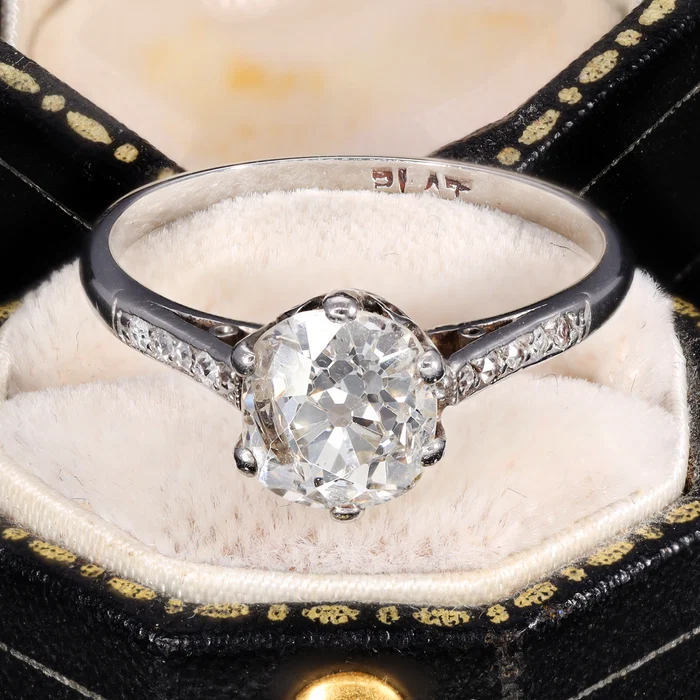
Genuine Art Deco engagement rings, meaning pieces made roughly between 1920 and 1935, are overwhelmingly platinum. The period coincided with the metal becoming workable at scale, and platinum’s strength allowed the fine, sharp detail the style depends on.
White gold does appear in the era, particularly toward the end of it and in more modest pieces, but a ring described as Deco in 14k white gold warrants closer questions. Modern reproductions frequently use white gold because it costs less to produce.
Platinum also ages in a specific way. It develops a soft surface patina from decades of contact rather than wearing thin. A ring with genuinely crisp, unmarked surfaces and no evidence of a century of handling is either heavily refinished or not old.
Read the Diamond Cutting
This is the single most reliable indicator, and it is difficult to fake convincingly.
Diamonds cut during the period are old European cuts, characterized by a small table, a high crown, a rounded girdle, and an open culet visible as a small circle when you look straight down through the stone. Under warm light they throw broad, slow flashes rather than the fine, rapid scintillation of a modern round brilliant.
A ring set with modern brilliants is either a reproduction or a period mounting that has been re-stoned. Both are legitimate items, but both should be priced and disclosed accordingly. Ask directly whether the center stone is original to the mounting.
Baguettes and other step cuts appear frequently as side stones. Period baguettes often show slightly irregular proportions, since they were cut by hand to fit a specific setting rather than to standardized dimensions.
Examine the Construction
Turn the ring over. The underside tells you more than the top.
Period pieces show hand fabrication. Look for milgrain that varies subtly along its length, evidence of hand engraving on the gallery and shoulders, and open filigree work with slightly irregular spacing. Cast reproductions produce milgrain that is perfectly uniform and filigree that looks slightly soft or rounded, because casting cannot hold the same crisp edge as hand piercing.
Check whether the gallery, meaning the underside structure beneath the stones, is finished. Period makers detailed areas no one would normally see. Volume production generally does not.
Hallmarks and What They Do and Do Not Prove
Many genuine period rings carry a platinum mark, a maker’s mark, or both. Many others carry nothing at all, since marking practice varied by country and was not always required.
An absent hallmark therefore proves very little on its own. A present hallmark is useful supporting evidence but is also the easiest element to reproduce. Treat marks as one data point among several rather than as proof.
Colored Stones and Calibrated Cutting
Deco rings frequently pair diamonds with sapphire, emerald, onyx, or ruby, cut to fit precise channel and bezel settings. This calibrated cutting is labor intensive and is one reason genuine pieces command what they do.
Be aware that synthetic sapphires and rubies were produced commercially during the period and appear in authentic pieces. Their presence does not indicate a fake. It does affect value, and a knowledgeable seller will identify them.
Questions Worth Asking a Seller
Ask whether the center stone is original to the mounting. Ask what repairs, retipping, or shank replacement the ring has undergone. Ask whether the piece has been refinished or replated. Ask for the basis of the era attribution.
A specialist will answer all four without hesitation and will volunteer detail you did not think to request. Evasiveness on any of them is informative.
Living With a Century-Old Ring
A genuine piece will be worn daily for decades, so practicality matters.
Filigree and fine milgrain can catch on fabric and accumulate residue, so periodic professional cleaning helps. Resizing is often limited, particularly on rings with stones set around the band or with engraved shanks, so confirm the achievable range before purchase. Have prongs inspected annually by a jeweler experienced with antique settings.
Buying With Confidence
The market rewards buyers who know what to examine. Check the metal, read the stone cutting, inspect the underside, and ask direct questions about originality and repair history.
For buyers who would rather work with a specialist than authenticate alone, Gesner Estate Jewelry deals in genuine period pieces with documented condition and provenance detail. Visit the site to see what is currently available.